
Are your timber floorboards showing signs of water damage, termite infestation, cupping, or persistent squeaking? we handle everything from single-board replacements to full-room restorations, matching timber species and stain color so precisely that the repair becomes invisible. Whether your older Queenslander home needs a few boards swapped out or your entire floor needs professional attention, our team provides an honest assessment, and deliver a free, no-obligation quote.
What is Timber Floorboard Repair?
Wood, being a natural material, is prone to damage over time from external and internal factors such as environmental effects and structural changes. In Brisbane, professional timber floorboard repair restores damaged, worn, or unsightly wooden floors to their original condition or better.
The repair process may include:
- Fixing scratches and dents
- Closing gaps
- Repairing water damage
- Treating rot or termite infestation
- Replacing individual boards for safety
Proper maintenance and regular cleaning extend the life of timber floors. Regular care also helps save significant costs on repair and restoration. We take pride in providing professional timber floorboard repair and replacement services in Brisbane. Our team of skilled professionals has years of experience in repairs and replacement.
Get a Free Quote Call: 0418 882 678
Let us discuss why maintenance, repair, and replacement is necessary and how it is done.
WHY DO TIMBER FLOOR BOARDS NEED REPAIR AND REPLACEMENT?
Brisbane’s hot, humid summers and mild winters affect the wooden floors. Understanding how Brisbane’s environment affects timber floors and how to manage those effects is essential. Timber floors are undoubtedly resistant to harsh environments, but can get damaged and require treatment.
The following are some of the possible reasons.
Why moisture and humidity is a problem for timber floors?
Changes in humidity levels, especially in summer, can cause timber boards to expand. Moisture control has a positive effect. This prevents issues like cupping, warping, or swelling of the boards. During seasons of heavy rainfall, here is a higher risk of damage, especially on outdoor decks and verandahs: poor ventilation and leaks in the house result in water seepage and damage. Water penetration in the wood can cause warping, cupping, buckling, or softening, compromising the integrity. A moist and humid environment is favorable for mold growth and leads to the replacement.
Expansion and contraction of the wood due to the changes in its moisture content is unluckily a course of events that do not leave the timber floor without causing damage. The most common challenge that is faced is the concave and convex deformities and loosening of the boards with their adjacent ones.
Sunlight and UV fading
On one hand, timber floors add beauty to your house, but on the other hand, they are also prone to getting damaged by excessive exposure to sunlight. This leads to fading of the wood with time ultimately, surface will look uneven. This can be corrected by replacing the boards or staining them with the same color as of surrounding, unchanged boards.
Scraping furniture across the ground
Furniture scratching the wood is a common problem and is reversible through the use of proper techniques and materials. This can be prevented by lifting the furniture instead of dragging it while moving it from one place to another, use of area rugs, or installing furniture pads to avoid marks left when furniture is placed for a very long time.
How so temperature changes affect timber floors?
Seasonal changes in Brisbane affect the structure. Timber expands and contracts as the days become warm and nights get cold. This change is either the expansion or contraction of the floorboards. Temperature fluctuations can lead to gaps between, which may require filling or repair to maintain integrity.
How do termites damage timber floors?
Brisbane’s warm climate and abundance of wooden homes are inviting features for termites. The termite can cause extensive damage by feeding on the wood in no time. Soft or hollow-sounding, visible tunnels, or droppings (frass) are signs of termite infestation. Replacing the termite-damaged floorboards and using termite control products mitigates the damage and prevents further infestation.
Squeaky and noisy floorboards
Homes with high levels of foot traffic or older homes have noisy boards. Squeaky noise occurs due to shifting joists, uneven boards, worn-out nails, or gaps. The crackling noise indicates brittle wood that can break at any moment. Floorboard replacement and professional maintenance prevent any future accidents and can help eliminate the noise.
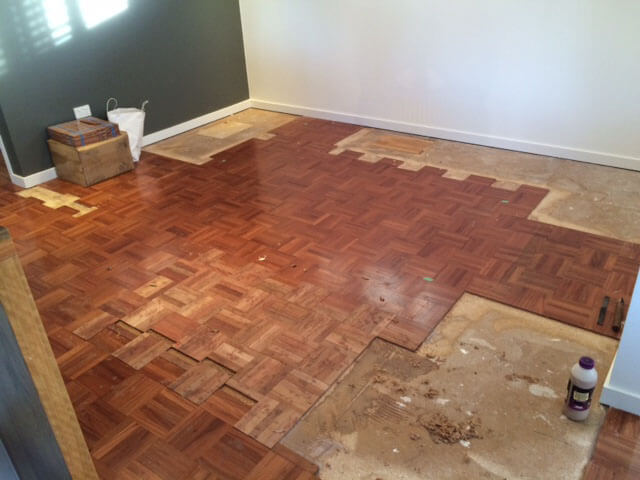
Our Timber Floorboard Repair Process
We can repair or replace floorboards damaged by termite and borer infestation, and stain the replacement timber to a similar color to the original.
Our Color Matching Skills
Floorboard replacement is carried out in such a manner that no evidence of the replacement will be apparent when viewing. You will be amazed by our careful color-matching skills.
Similar colored boards are sourced and when color variations occur, wood staining is performed to blend the new with the original surrounding ones. Staining of the whole area is avoided as it may increase the cost of the work and also increase the time required for the completion of the whole process, which includes the drying time.
Source of Floorboards
Older original wood can sometimes be sourced from timber demolition yards, but this can be time-consuming, troublesome, and a more expensive option. Stained new floorboards are an option.
Get a Free Quote Call: 0418 882 678
What are the Available Options For Timber Floor Repair?
Surface Scratches and Scuffs treatment
Floor sanding is one of the most common methods to repair, especially surface-level scratches and general wear and tear. Special Sanders sand the floor and repair minor scratches and dents, revealing the fresh, undamaged wood beneath. After sanding, a finishing is applied that restores the wood`s shine and protects it from future damage from water, pests, and the environment.
Restoration of water-damaged timber floors
Brisbane’s humid environment is welcoming for timber damage. Moisture penetrates the wood-causing damage.
How to restore water damaged floors:
- Assessing the condition: The restoration begins with evaluating the extent of water damage. Our team also checks the subfloor for damages. A humidity meter determines the severity of the problem.
- Drying and ventilation: Proper ventilation is maintained, and any moisture left is dried using drying equipment.
- Replacement: Severely damaged floorboards cannot be repaired, so they are replaced with new, matching timber. In cases of minor warping, sanding may be sufficient to restore the boards.
- Moisture Barrier: Newly constructed homes have a moisture barrier between the top and the subfloor to prevent water damage. The moisture barrier helps to protect the timber from rising dampness and moisture intrusion.
- Finishing: Finishing the floor restores the original beauty and shine.
Floorboard Gaps Filling
Gaps between floorboards occur due to the expansion and contraction of timber in response to humidity and temperature changes. Gaps can result in trip and fall injuries and can collect dirt and debris.
What is The process of gap filling:
- Cleaning: The floor is cleaned through a vacuum or a broom before filling.
- Filling with a wood filler: We use timber floor color matching, specialized wood filler, or compound. Timber fillets (thin wood pieces) are also commonly used for wide gaps.
- Sanding and Finishing: After manually filling the gaps with the filler, the floor is sanded and refinished to ensure a smooth, even surface.
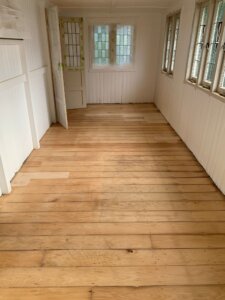
Noisy Floor Fixing
When the floorboards leave their space or have loose nails, a characteristic noise is formed whenever someone walks. This squeaky and crackly noise is unpleasant and can be an annoyance that disrupts the peace of your home. Our team can fix squeaky floors by securing loose boards and ensuring that it is stable and quiet.
What is The process of fixing squeaky floors
- Problem Identification: the first step in fixing squeaky floorboards is to assess the noise. It can be loose nails, screws, or joists.
- Boards securing: Our team of experts uses a professional approach to fix and secure loose boards. The methods include driving new nails or screws into the joists or using adhesive to bond the boards to the subfloor.
- Sanding and Finishing: After the boards are secured, the floor is sanded and polished to fix the damage caused during the repair process.
Termite Damage Repair
Termite and pest infestation damage the structural integrity. If left untreated, termites can spread to other areas of your home. We offer comprehensive termite damage repair services to restore the safety and beauty.
What are The Steps for fixing termite-damaged floors
- Floor Inspection: Our professional team will assess the termite damage and provide a quote on whether any structural repairs are needed.
- Professional Treatment: For a massive infestation, we recommend contacting a pest control team to treat the infestation before we proceed with repairs.
- Board Replacement: After careful inspection and treating the termite, the damaged floorboards are removed and replaced with new ones. Sometimes, the subfloor may also need to be treated or repaired.
- Sanding and Finishing: Sanding and finishing are the final steps that blend the new boards with the rest of the floor.
When should one consider timber floor replacement?
Replacement is necessary in the following situations:
- Extensive Damage: Extensive water damage, structural issues, or termite infestation are conditions where replacing the entire floor may be more cost-effective than repairing individual boards.
- Home renovation: If you’re upgrading your home and want to change the style and type of timber floors, replacement may be the best option.
- Subfloor Issues: Floor replacement fixes any issues related to the subfloor. A damaged or unstable subfloor is dangerous for the flooring structure.
The Replacement Process
The timber floor replacement process consists of five steps.
Assessment Of The Floor
The first step is a detailed inspection of the floor. Our team will evaluate the extent of the damage and provide you with a transparent quote. The quote comprises the costs and timeline for the floor replacement project.
Timber Selection
The second step is to select the timber that matches and enhances the aesthetic appeal of your home. Popular timber species for flooring are Spotted Gum, Australian hardwoods like Blackbutt and Ironbark, as well as exotic options like European Oak and American Walnut.
Subfloor Preparation
After removing the old planks, we ensure the subfloor is intact and in good condition. Our team will make necessary changes and repairs if necessary. These may include leveling the subfloor, installing moisture barriers, or reinforcing joists.
Installation of New Floorboards
After ensuring the it is intact and ready to take the new top, we begin installing the new floorboards. Each board is placed precisely, considering consistent spacing and alignment throughout the floor.
Sanding and Finishing
The floor sanding creates a smooth and even surface. We clear the clutter( wood pieces and dust) and clean the entire floor to prepare it for finishing. Finally, we apply a high-quality finish to protect the timber and enhance its natural beauty. Types of finishes include oil-based, water-based, and polyurethane coatings, so you can choose the finish that best suits your needs.
Get a Free Quote Call: 0418 882 678
Trust Budget Floor Sanding for Your Timber Floor Repairs and Replacement in Brisbane
Timber floors require persistent care and attention to maintain aesthetic appeal and durability. We are here to help with minor repairs, board replacement, or a complete restoration. We’ll ensure floor restoration to its original charm and strength.
Our team of skilled professionals delivers high-quality results that stand the test of time. Contact us today for a free consultation, and let us help you protect and enhance your timber floors for years to come.
Get a Free Quote Call: 0418 882 678
Frequently asked questions about timber floor board repair and replacement in Brisbane
What are the signs that the timber floor needs repair?
Timber floors show signs that indicate the need for repairs:
- Scratches and dents that form from furniture or pets.
- Cupping or warping is caused by moisture changes.
- Noisy or squeaky boards that result from weakened nails or subfloor issues.
- Gaps between boards are often due to expansion and contraction.
- Discoloration may indicate water damage or excessive sunlight exposure.
Can individual timber boards be replaced, or do I need the entire floor replacement?
Yes, individual boards can be replaced. The signs that indicate the need for floorboard replacement are:
- Splits and Cracks in the floorboard. Replace damaged boards while preserving the rest.
- Termite damage: Infestation at certain specific parts of the floor. Only the affected boards are removed.
- Water damage: Replace the boards near the affected area, such as near leaks or windows.
How much time is required to repair or replace timber floorboards?
The time required depends on the scope and intensity of the project:
- Minor repairs take usually 1-2 days including sanding, filling, or replacing a few boards.
- For Large-scale repairs or partial replacements, professionals May need 3-4 days.
- When complete floor replacement is required, the team requires a week or maybe more. The process includes sanding, installation, and finishing. Drying time for finishes and the size of the area being worked on will influence the timeline.
What are the best timber types that are suitable for Brisbane’s climate?
Timber types with high moisture resistance and durability are ideal for Brisbane’s climate.
- Blackbutt: It is an Australian hardwood that is popular for its high durability and pleasing color.
- Spotted Gum: It is a durable, dense hardwood native to Australia. Spotted Gum shows resistance to moisture and termites.
- Jarrah: It is among the top timbers that perform well in Brisbane’s humid and warm climate. It offers excellent resistance to termites and wear.
- Ironbark: Known for its strength and resilience in humid climates.
Can water-damaged timber floors be repaired?
Yes, water-damaged floors can often be repaired, depending on the severity of the damage. If there is minor damage( cupping or warping), sanding and refinishing is sufficient. For moderate to severely damaged floors, replacement of both may be required.
How squeaky timber floors can be repaired?
Squeaky or noisy floors are caused by loose boards or subfloor issues. The repair process includes locating the source of noise and securing the boards and subfloor reinforcement to prevent movement between the boards and joists.
How to fill the gaps formed in timber floors?
Gap filling is a technique used to repair gaps between timber boards. The gaps develop due to the expansion and contraction of the floorboards. The process of filling gaps involves:
- Cleaning the gaps of dirt and debris
- Filling the gaps using a specialized wood filler(wood putty or timber fillets).
- Sanding and finishing to create a smooth, even surface.
How can I protect my timber floors from moisture damage?
Following simple steps, you can prevent your timber floors from getting damaged by moisture:
- Install moisture barriers: They prevent the moisture from the top floor from reaching the subfloor. They are beneficial, especially in areas prone to high humidity or water exposure.
- Humidity control: Dehumidifiers control humidity to prevent the expansion and contraction of the timber.
- Clean spills immediately: Clean up spills promptly to avoid water seeping into the wood.
Why do timber floorboards warp or cup?
Timber floorboards warp or cup due to moisture imbalances. Excess moisture swells the underside of the board, leading to cupping. High humidity levels cause timber to expand unevenly. Warping or cupping is caused by leaks or flooding. Insufficient ventilation beneath the floor can lead to moisture buildup in the subfloor.